
Spotter's Guide: The Tiger Beetle
Enrich your experience of nature by getting to know different species...

One of the things that can really elevate a nature walk, is knowing what you’re looking at, and why it’s doing what it’s doing. This is all part of learning how to slow down and enjoy the good things that surround us. The rich tapestry of drama and story folded into every species is part of what makes nature endlessly rewarding.
So here’s a quick spotter’s guide for one particular species you might find when you’re out and about…
As we explore the miniature escarpments of an old granite quarry, we happen upon this beautiful little creature, basking in the afternoon sun. She is a green tiger beetle, and she’s a deadly hunter.
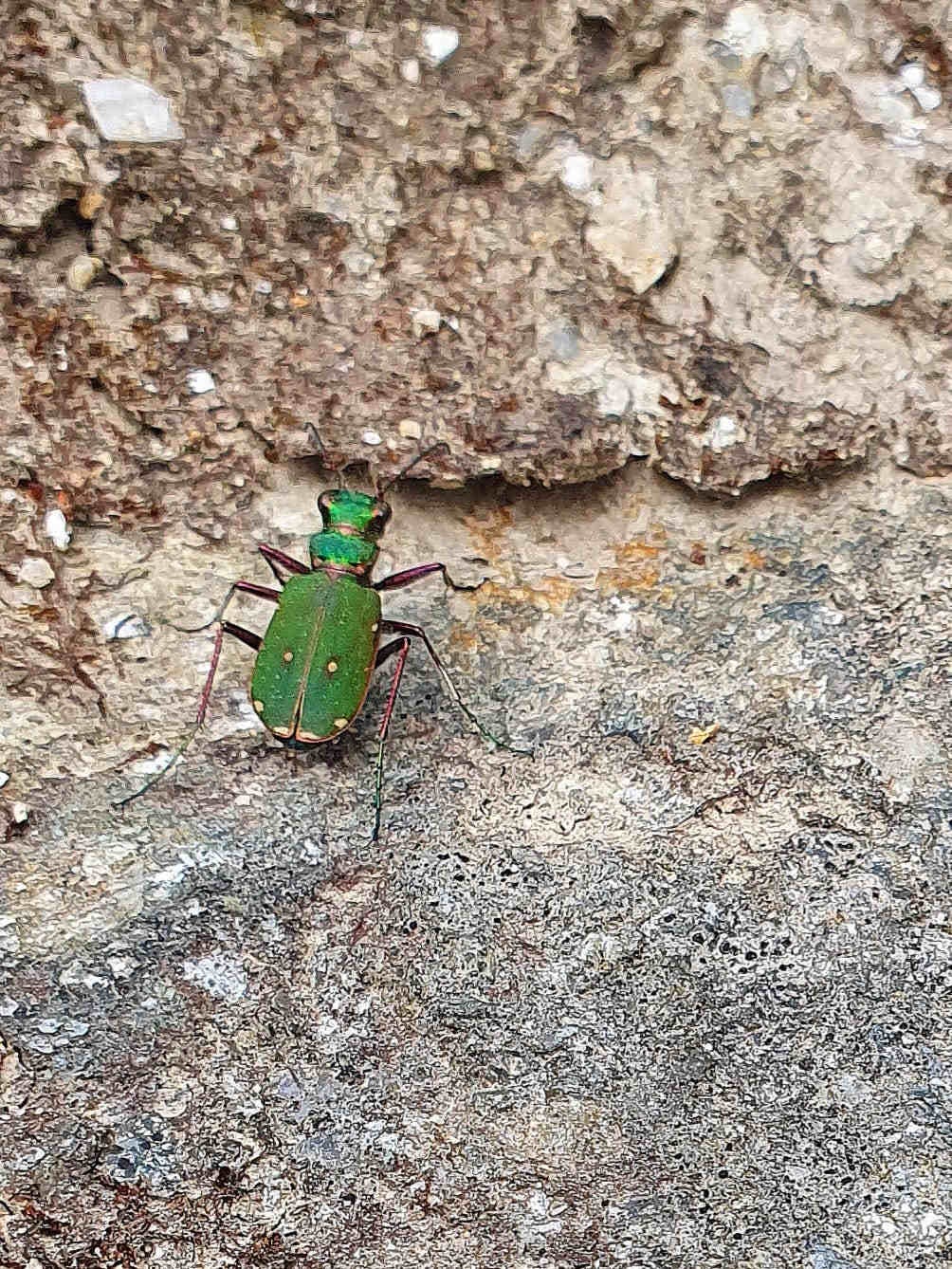
This particular subspecies of tiger beetle sports a gorgeous metallic war paint, and can be found all over Europe, from Spain to Finland. But there are more than 2600 types of tiger beetles worldwide, found on all continents except Antarctica. So wherever you are, keep a lookout.
Let’s shrink our awareness down to the scale of an insect, and experience what life tiger beetles lead, directly under our feet.
To begin with, you have to watch out for those giant footfalls of other people, looming out of the sky and dislodging avalanches of scree. Luckily, the smaller size of the tiger beetle’s brain means that thought processes have far less distance to travel across the neural network. Hence, she processes her environment far faster than we humans, causing time to effectively pass seven times slower. Some of her thinking is decentralised across her body, meaning her legs can start running on their own, in response to outside stimulus, before the brain is even conscious of what’s happening. I’m not sure I’d like my own limbs acting without my consent!
The nomenclature of tiger is afforded for good reason. The tiger beetle is a ferocious predator. At this small scale, you have to make sure she doesn’t spot you when she’s hungry, or her vicious mandibles will literally tear you apart. She can run up to 60 cm per second across clear ground, making her one of the fastest insects of her size. If she were the same size as a human, this lean green racing machine would be zooming along at 157 miles per hour!
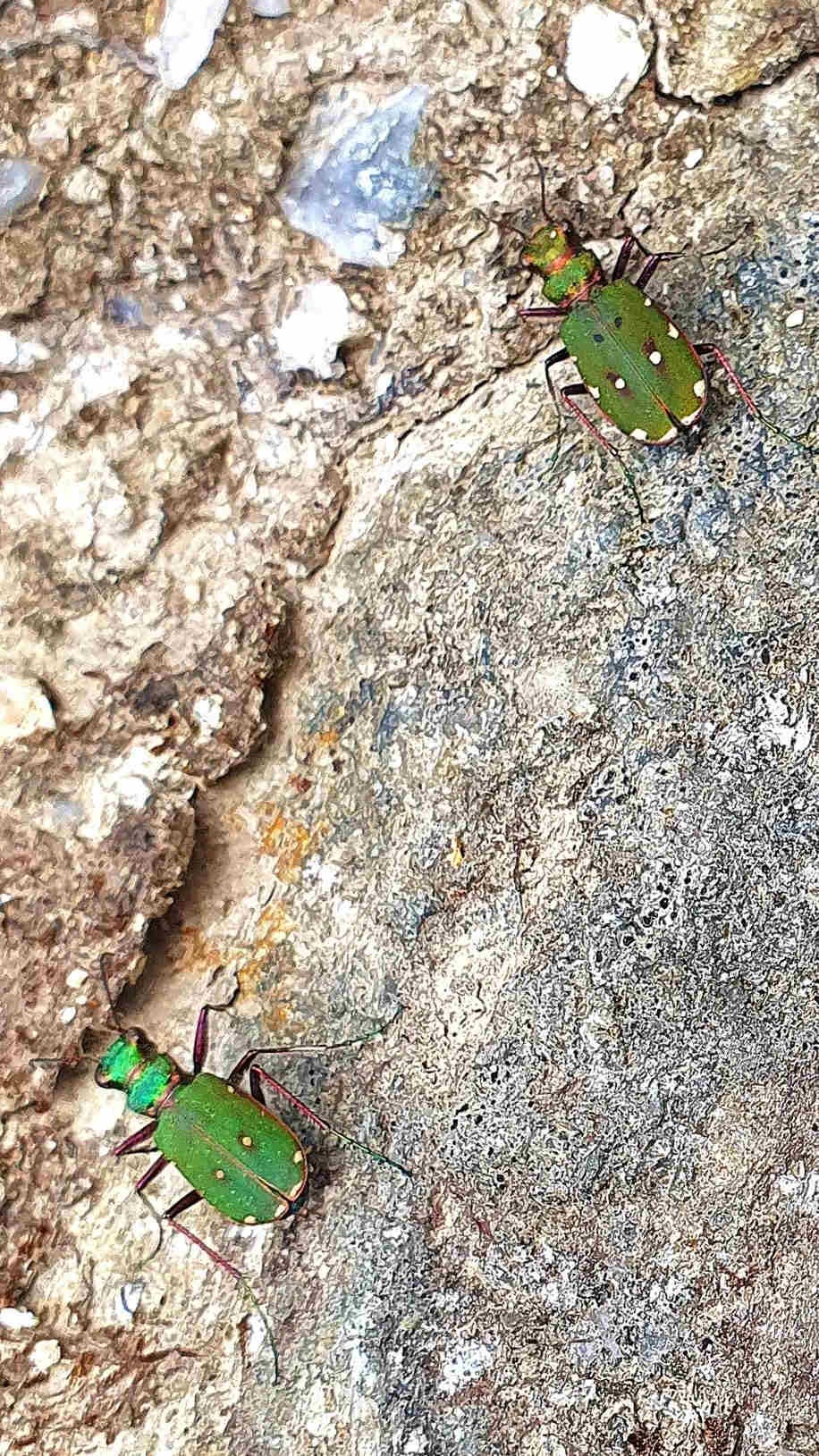
With her long, bronze legs, the tiger beetle moves so fast that she regularly overstimulates her senses, and has to stop to reorientate. So her hunts are both lightning fast, and stop start, as she chases down spiders, ants, or lumbering caterpillars (I guess the caterpillars don’t stand a chance!).
An ant, which can only run at 8 cm per second, will scurry over and under obstacles, trying to outwit its predator. But perhaps the ant’s best chance of escape is to remain absolutely still, as the beetle’s compound eyes, built to detect movement, cannot easily discern forms when they are motionless.
The tiger beetle hides her ears under her elytra, or wing-case, and can hear higher frequencies pretty well, even from sources underground. If you try speaking in a high tone, perhaps you might catch her attention.
This beetle has a great sense of smell, thanks to her various articulated antennae, and the white hairs on her legs help protect her from high temperatures, such as the sun-baked rock on which she stands, whilst alerting her to vibrations.
She is extremely territorial, often facing predators, as well as others of its kind, in order to protect her turf. And during mating, the male will try to impress her by doing press ups for several minutes. Actually, that is pretty impressive!
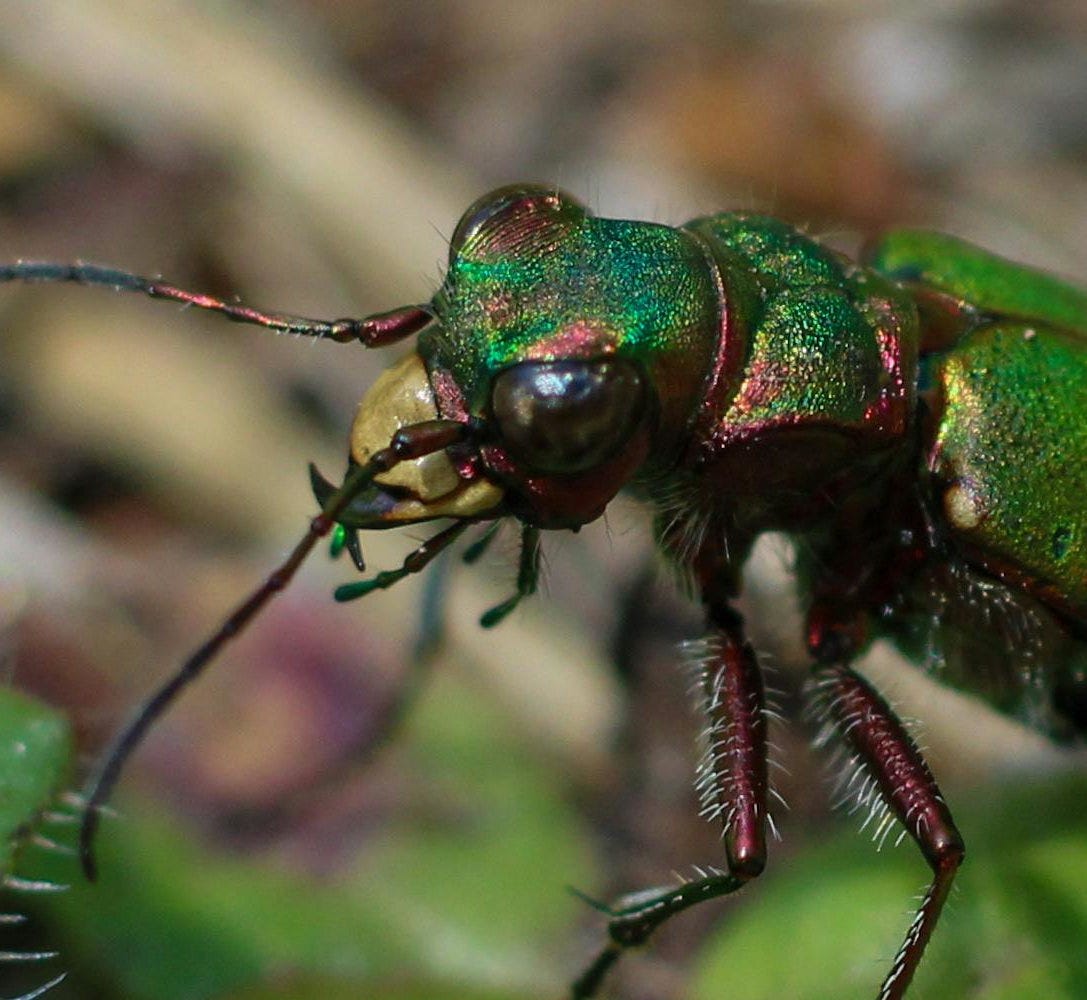
Tiger beetles can be found in various habitats, such as heathlands, moorlands and even mountains, often out in the open on sandy or chalky soils, or on rocks, bathing in the heat. Different species of are generally the colour of the habitat in which they hunt. You’ve probably passed one many a time.
Tiger beetles are mostly active during May till October, so keep an eye out for that telltale glint of her iridescent metallic forewing—because now you know a little more of her background, you’ll be able to follow her fascinating story, as it unfolds at your feet.
Learn the art of slow living, through nature…
If you suffer from stress, burnout, overwhelm or anxiety, then perhaps it’s time to slow down a little. Modern life tends to encourage us to stay ‘switched on’ all of the time, causing all kinds of mental, physical and emotional problems. Perhaps you’ve experienced this yourself.
Learning to slow down is essential to your long-term health and quality of life. And getting yourself out into nature is the simplest way to do it.
If you’re feeling the strain of modern living, learn with me how to harness the healing power of nature…
Around where I live, in Groningen, the Netherlands, I see northern dune tiger beetles very often. Often sand or dune areas will have lots of them.
I don't remember ever seeing this beetle in the UK. A bit strange, as I love insects. Makes me wonder how many other tiny wonders I've missed- and am still missing probably!
I love bugs with this kind of metallic sheen. Today, I was watching a few moths with a similar shimmer and emerald-green rose chafer beetles that occasionally flash gold. Nature is amazing.